Choosing the right niche is the most important decision you'll make when launching a job board.
Not your tech stack. Not your logo. Not even your pricing.
If you pick the wrong niche, growth will feel impossible. If you pick the right one, SEO, marketing, and monetization become much easier.

Here's a simple, practical framework to help you choose wisely.
Step 1: Do Your Research (Look Where Demand Already Exists)
Don't guess. Observe.
1. Search Reddit and Online Communities
Go to Reddit and search for questions like:
- "Where can I find jobs in X?"
- "Best job board for Y?"
- "Anyone hiring in Z?"
If people are complaining about existing job boards, sharing improvised Google Sheets with job listings, or posting jobs manually in threads, that's a signal. It means the market is underserved.
Strong niches usually have active communities: subreddits, Slack or Discord groups, LinkedIn groups, and industry newsletters. If thousands of professionals are already talking about careers in that space, demand already exists.
2. Analyze Successful Niche Job Boards
Study what's already working. Look at examples like:
- Echojobs: Software engineering jobs only
- 4 Day Week: 4 day week roles only
- Remote Nurse Connection: remote nursing job only
- Data Science Jobs: Data scientist jobs only
Ask yourself: who exactly do they serve? What do they exclude? What professional identity do they reinforce?
The exclusion is the niche. The more clearly a platform says "this is not for everyone," the stronger it becomes for its target audience.
3. Use SEO Tools to Validate Search Demand
Use tools like Ahrefs, SEMrush, Google Keyword Planner, or our FREE Keyword Research Tool For Job Boards to find keywords with:
- Long-tail structure and buyer intent
- Moderate search volume
- Low competition
- Low-DR competitors already ranking
For example, instead of chasing "marketing jobs," look for more specific terms:
- "remote healthcare compliance jobs"
- "cybersecurity jobs for startups"
- "visa sponsored nurse jobs Germany"
Specific = rankable. Broad = invisible.
Step 2: Make Sure It's Monetizable
A niche is useless if employers won't pay. Before you build anything, ask:
- Do companies in this niche make money?
- Is hiring frequent and ongoing?
- Are roles hard to fill?
- Do companies have dedicated marketing or recruiting budgets?
Strong, monetizable niches typically share these traits: skill shortages, high average salaries, specialized talent pools, and growing industries.
Weak niches tend to involve low salaries, one-time or seasonal hiring, students or unpaid internships, or extremely small local businesses.
The clearest test:
Would a company realistically pay $99–$299 to post a job here?
If the answer is "probably not," rethink the niche.
Want Real Examples?
If you’re not sure which industries have the strongest revenue potential, check out our detailed breakdown:
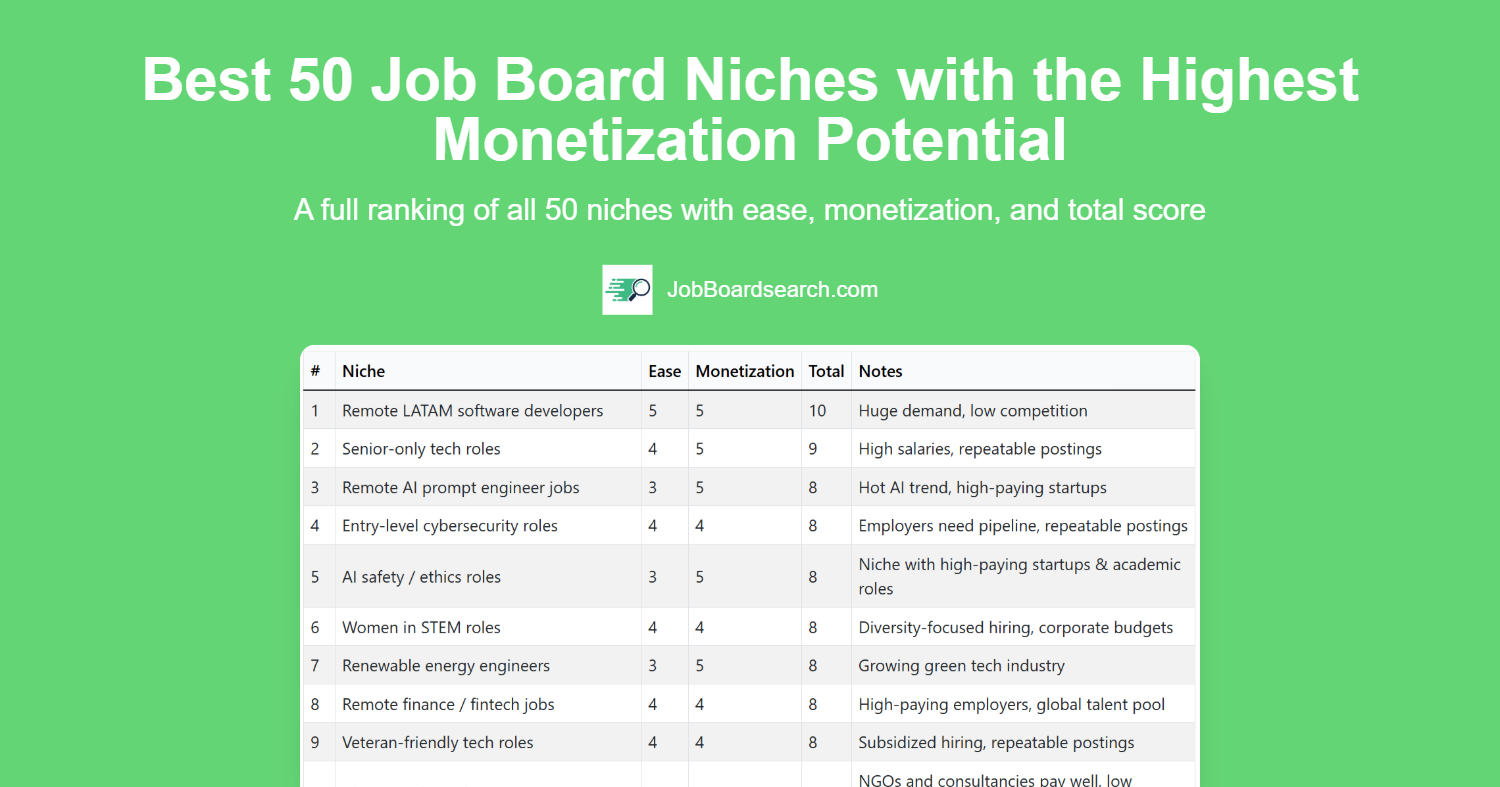
👉🏻 Best 50 Job Board Niches with the Highest Monetization Potential
It includes high-paying industries, hiring frequency insights, and niches where companies are already spending on recruitment.
Step 3: Founder Fit ( Your Unfair Advantage)
A niche works much better when you already belong to the world you're serving. That means:
- You understand the industry's language and culture
- You have access to relevant communities
- You can produce content that resonates
- You can sell to employers with credibility
Without that fit, you'll struggle to write SEO articles, build authority, earn trust, and close your first paying customers.
Many of the most successful niche job boards were built by insiders. If you're already in the industry, you bring credibility, an existing network, and market intuition that outsiders simply can't fake. That's a massive competitive advantage.
Step 4: The 5-Question Validation Test
Before building anything, answer these five questions honestly:
- Are there active communities of professionals in this niche?
- Are companies actively and repeatedly hiring?
- Can you find at least 100 live job postings right now?
- Would a company realistically pay $99–$299 to post here?
- Can you write 50 SEO articles about this niche without running out of ideas?
4 out of 5 YES answers = strong signal. Struggling to answer 3 or more? Reconsider the niche.
✅ Your niche passes 4/5 questions? Fantastic! The next step is to list your job board on JobBoardSearch and start connecting with employers and job seekers immediately.
What the Best Niche Is NOT
It's not simply asking: "What's popular right now?"
Popularity usually brings massive competition, general job boards already dominating search results, and expensive, slow SEO. Chasing trends without a specific angle is a losing strategy.
What the Best Niche Actually Is
A great niche is where hiring is constant, competition is moderate, and professional identity is strong.
You're looking for the intersection of:
- Ongoing hiring demand: not seasonal, not one-time
- A defined professional identity: people in this field know they're "in this field"
- Clear audience messaging: easy to explain who the board is for
- Room to rank organically: SEO is achievable without a massive budget
That intersection is where profitable niche job boards are built.
Final Advice
Take your time here. Niche selection isn't a quick decision, it's your foundation.
When you choose a niche with real demand, monetization potential, SEO opportunity, and genuine founder fit, you don't just launch a job board.
You build something with a real chance of surviving, and thriving, past year one.